Heritage Party issues formal objection: DEFRA must stop “breed erasure by proxy”- Dogs are not a political problem to be engineered out of society.

The Heritage Party is standing up for the constitutional rights of the people — whether it’s a family’s right to vote in local elections, or a family’s right to own a dog and live a normal life without “voluntary” rules turning into coercion by stealth
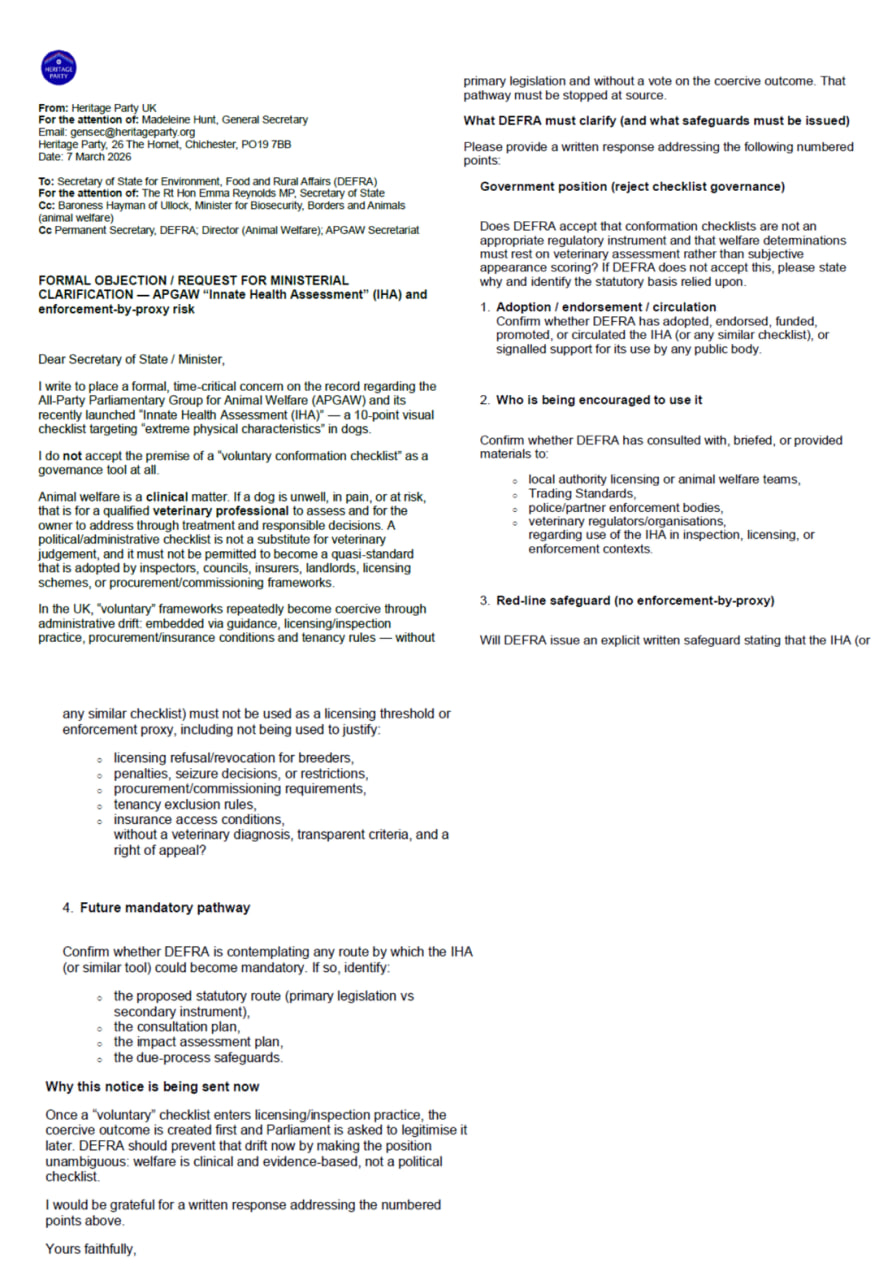
The Heritage Party has issued a formal objection to DEFRA regarding the All-Party Parliamentary Group for Animal Welfare (APGAW) “Innate Health Assessment (IHA)” — a 10-point conformation checklist being promoted as “voluntary”.
We do not accept any political/administrative checklist as a governance tool for animal welfare. Animal welfare is clinical: if a dog is unwell or at risk, that is for qualified veterinary assessment and responsible ownership — not a Parliament-linked checklist that can be adopted by inspectors, councils, insurers, landlords, licensing schemes or procurement rules.
The danger is obvious: “voluntary” today becomes mandatory in practice tomorrow. Once a checklist enters licensing/inspection culture, it becomes enforcement-by-proxy — effectively wiping out lawful breeds by administrative drift, without a Parliamentary vote.
Important clarification: APGAW is NOT Government
Most people hear “Parliamentary Group” and assume “Government” or an official Parliamentary committee. That is wrong.
APGAW is an APPG. APPGs are informal cross-party groups with no official status in Parliament. They are not Select Committees and they do not make law. Their influence is political and administrative: they publish proposals and push them into departments such as DEFRA, where they can later reappear as “guidance”, “best practice”, or “standards”.
Why owners are alarmed: the IHA criteria are so broad that critics warn it could apply across a very large number of established breeds — widely reported as “up to 67” popular breeds — because it targets physical traits found across many dogs (short legs, flat faces, skin folds, eye and ear issues). Even if the checklist is described as “voluntary”, the risk is that it becomes a de facto restriction through licensing and enforcement practice.
That is exactly why we are acting now: to stop an informal policy tool becoming a de facto national restriction by stealth.
Why this matters now: the “voluntary → enforced” trap
We have seen this pattern repeatedly across public policy. Initiatives are marketed as voluntary, and then become compulsory through the back door — embedded through licensing and inspection practice, procurement rules, insurance/tenancy exclusions, council enforcement, and “standard operating” guidance.
People have already lived through this logic in multiple areas of life: lockdown-era “guidance”, “voluntary” climate programmes, settlement and housing policy framing, and “locally led” reorganisation pathways and “voluntary” election postponement — all presented as optional until the administrative machine treats them as inevitable. The word “voluntary” is now routinely used as a cover for coercion-by-drift.
This must not happen with dog ownership.
Why reorganisation makes this worse
This risk is magnified by the shift toward larger unitary and combined-authority governance. When decision-making and enforcement guidance are concentrated into fewer, larger bodies, “voluntary” tools can be rolled out as standard practice across entire regions with fewer local checks and weaker local scrutiny.
Even without Parliament legislating a ban, administrative adoption can create the same outcome in practice — without a vote.
Our position
- Dogs are not a political problem to be engineered out of society.
- If a dog has a genuine welfare problem, a vet deals with it.
- A political/administrative checklist must not be allowed to decide what breeds can exist, who can own them, or whether families can keep them.
We are demanding that DEFRA draws a clear red line: no conformation checklist must be used as a licensing threshold or enforcement proxy.
Take action
Use our MP template letter to contact your MP and demand:
- DEFRA rejects conformation checklists as enforcement tools
- a written “red-line” safeguard: no licensing/penalty/seizure/exclusion decisions based on such checklists
- any mandatory change must require primary legislation, impact assessment, consultation, and due process
Links: